Who would have dreamed that a post-lunch hour online hang with 70 other folks from across Maine to talk about tax increment financing could be such a banger?
Alyssa Tibbetts, an municipal finance attorney in independent practice, and Jim Damicis, an economist and development finance expert at Camoin Associates, chaired the discussion. The assembled group of municipal managers, planners, developers, financiers, and lawmakers from across the state shared their experiences and offered some suggestions.
You’ll find a recording of the session below. The first 35 minutes or so is an overview of the subject, with a discussion coming at the end. Apologies for missing the first slide or two!
Note: If you’re not sure what TIF’s are but want to know, skip down to “WTF are TIFs” at the bottom of this post.
Otherwise, here’s the four big takeaways from our Community Council:
1) Municipal leaders need more tools and support to use TIFs, especially our small municipalities
Bigger municipalities with in-house counsel, full-time economic development staff, and a budget to hire great advisors (like Alyssa and Jim!) are pretty-well equipped to set up TIF districts. But it’s a big ask for a small municipal government with a couple of staff to set up a TIF district. That’s a shame.
Participants hoped that the new Maine Office of Community Affairs could increase support to small municipalities, and make the process as easy as possible for them to participate. Folks also agreed that networks like Build Maine could help close this gap with educational materials, mutual aid discussions, and events like this one.
2) When the public doesn’t trust government, or developers, everything gets harder
Over and over again, participants shared their struggles to help folks in their municipality to understand the mechanism and its functions. Some cited TIF districts that grew the municipal budget and helped paid for things that people want, but were opposed because of the belief that the developers would reap the benefits. Many TIFs include incentives to the developers, and media coverage often conflates the two.
Municipal affairs are tough in Maine right now. Budgets are tight. Many municipalities can’t afford to support the infrastructure they already have, let alone build out the infrastructure that new development requires, such as new roads, schools, and services. Second, and relatedly, is that residents, and often the folks they elect, believe that new developments will lead to higher taxes. A well-designed TIF district around a cost-effective project can help address both issues.
Again, folks hoped that groups like Build Maine and Maine Municipal Association would help build public understanding and trust. Participants were also interested in a tool they could use to estimate TIF impacts. Some also sought more support and guidance on what makes a successful TIF in the long run, so they can explain their reasoning to a skeptical public.
3) Municipalities would love for application and approval to get cheaper, easier, faster, and more transparent
Several participants noted that the application process is cumbersome and, at times, misaligned with municipal needs. Establishing a TIF one requires deliberations and analysis, a bunch of steps of administrative work, a vote by a council or town meeting, and only after that does the state review and approve or reject the application. It’s a lot to invest, especially for small municipalities with minimal staff and only occasional select board authority. According to statute, the state’s role is to ensure compliance, though some participants wanted more clarity on this. The group was interested in seeing a more streamlined process for setting up a TIF, and potentially a unified online proposal submission system for both DECD and MaineHousing applications.
4) Some thought the law could be improved, too
There were varied opinions among the group about whether the Maine’s TIF legislation could be improved. Some participants said that the restrictions on how the money could be spent overlook the actual needs of municipalities. The law limits how funds can be spent to things that municipalities may already have in spades, like roads and utilities, when the municipality badly needs to repair school facilities. Some municipalities have money piling up in TIF funds that they don’t need for infrastructure, but would like to use for municipal operations. Houlton had TIF funds stacking up for years and struggled to figure out a useful way to spend them. Another suggestion was to explore ways to allow parcel-specific TIFs to cover single-parcel projects, such as the redevelopment of an abandoned mill building or legacy brownstone.
Do you want to get involved?
We are organizing a follow-up discussion for folks interested in following-up on some of these ideas. If you’d like to get involved, let us know and we’ll put you in touch with Jim and the rest of the group!
Wait, WTF are TIFs again?
If all of the above was lost on you, but you feel like you need to know it: there are no judgements made at Build Maine Community Council. Especially from me, I’m still learning too.
To clarify, tax increment financing (TIF) is a tool that municipalities can use to finance projects or debt. Municipal TIF districts allow the municipal government to insulate future property tax revenue from state and county revenue sharing. As property values rise in an approved TIF district, the municipality can ‘capture’ the additional revenue generated from development, for years.
Here’s a compact 2-page explainer by the Town of Falmouth and a presentation for the City of Ellsworth. There’s also slightly different rules and processes for economic development and affordable housing TIFs, as this resource from Gardiner explains.
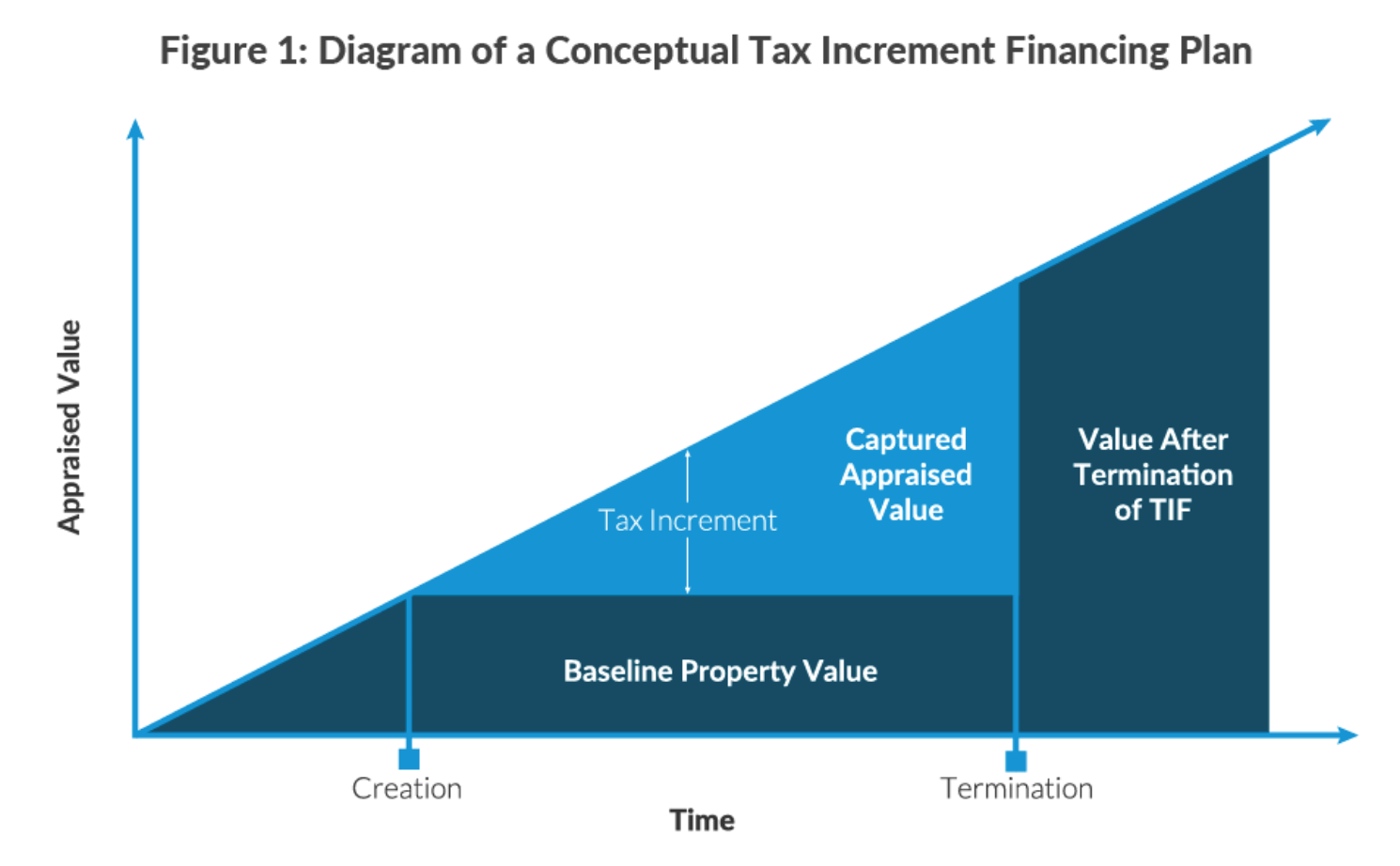
Maine’s municipalities are heavily reliant on property taxes to fund their operations. Property values and the taxes that their owners pay are the primary way they fund schools, road maintenance, plowing, garbage collection, parks, recreation programs, you name it. By some measures, Maine’s 450+ municipalities are more dependent on this one source of revenue than local governments in any other state. So, by protecting property tax revenue when its value increases, the municipal budget can fend off losses in state aid to education, state sales tax revenue sharing, and an increase in county tax payments.